Side project · 2026
ElectoQuiz
Vote for proposals, not parties.
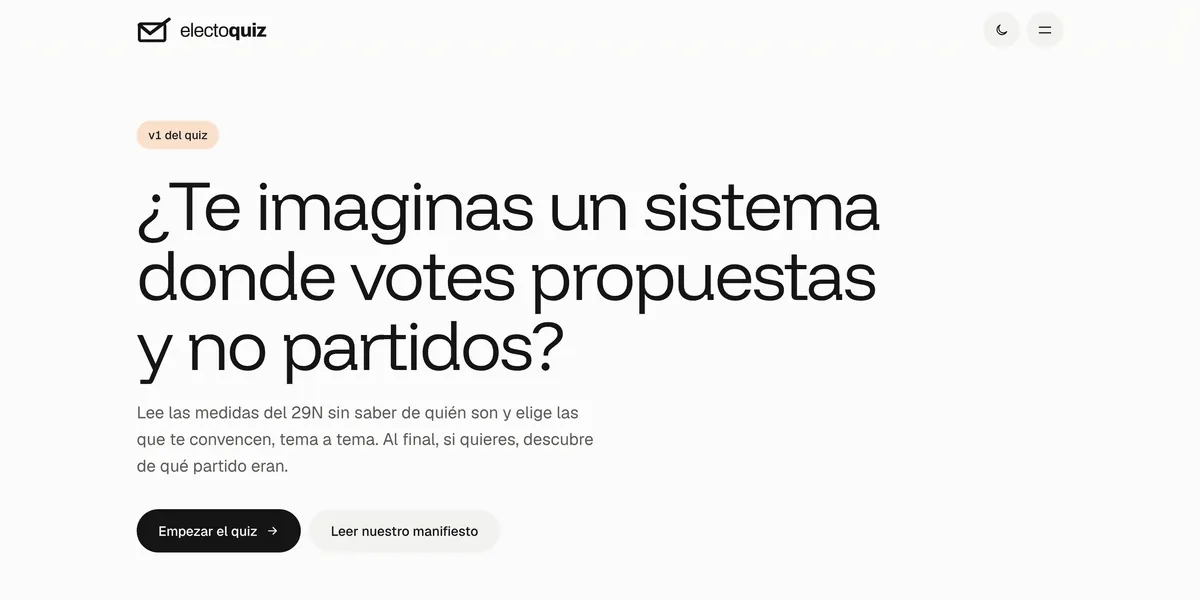
A blind quiz for Spain's general election on 29 November. For each topic you read six proposals taken from the manifestos, with no party names, and pick the one you find most convincing. At the end, if you want, you find out whose each one was.
- Role
- Idea · Design · Development
- Year
- 2026
- Product
- Civic quiz and official data monitor
- Team
- Me, coding with AI
01 · The starting point
We vote for closed packages
Hardly anyone agrees with a party on everything, yet we vote for logos, not ideas. When we know whose proposal it is, we tend to decide before reading it: if it comes from our side it sounds sensible, and if it comes from the other side we look for the flaw.
I wanted a way to read the 29 November manifestos without that filter: the idea first, and the party only at the end.
02 · How it works
Nine topics, six proposals each, no party names
- You read without logos
Six proposals per topic, one from each party, all in the same format.
- You pick or skip
One per topic, or «I don't know», «None convinces me» or your own.
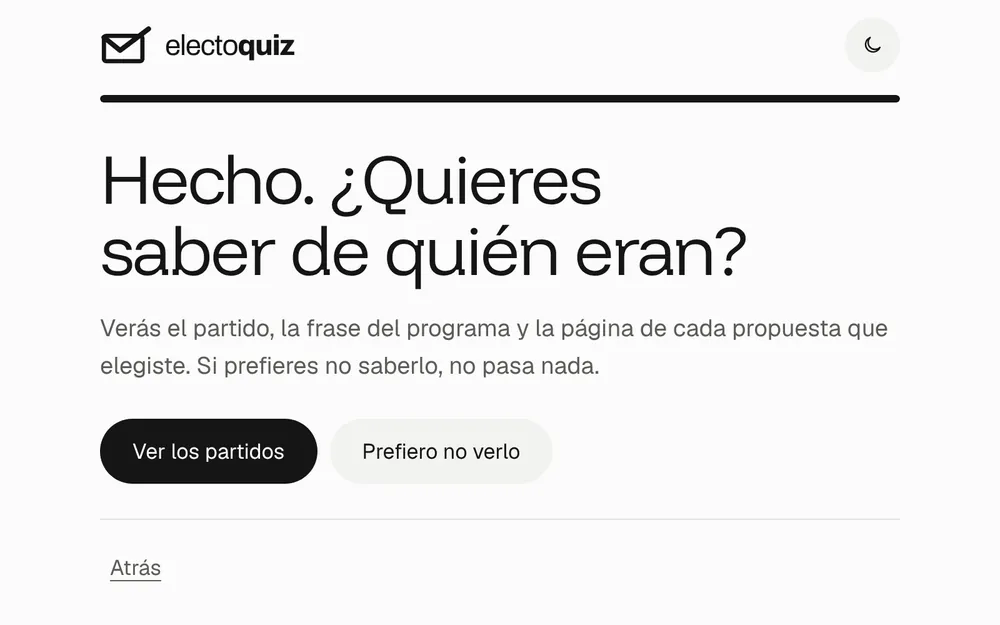
- You decide whether to look
«Want to know whose they were?» You can choose not to.
- You find out
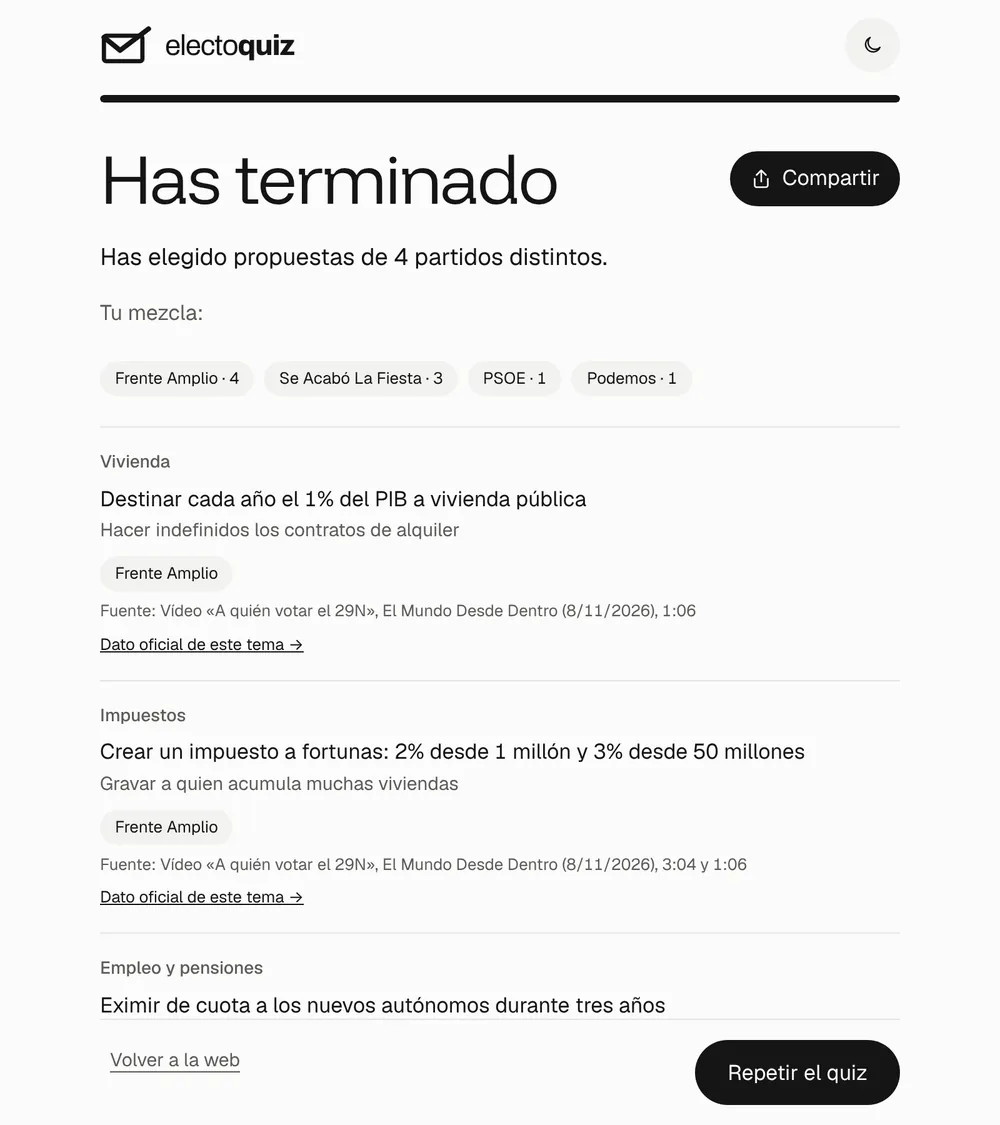
How many different parties you picked, the source of each proposal and the official figure for each topic.
The quiz journey. Diagram.
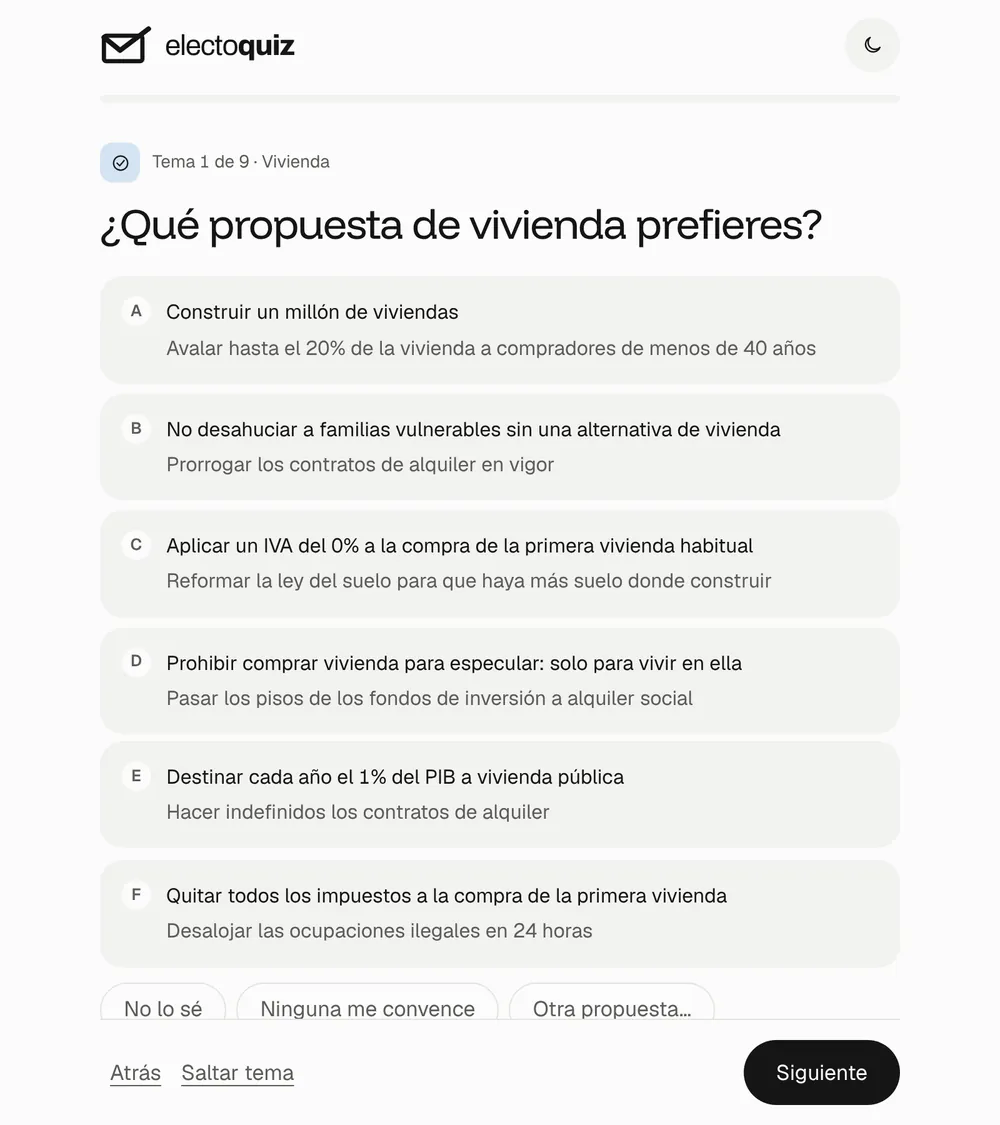
Housing, taxes, jobs and pensions, healthcare, education, immigration, territorial model, Europe and defence, and energy. The proposals come from Spain's six main national parties.
03 · Decision 01
Neutral by design, not by promise
In a project like this, trust is everything: if a single card gives its party away, the quiz is useless. That's why neutrality isn't in a legal notice; it's in how every screen is built.
No logo, colour or party name until the end. Cards are labelled with letters from A to F.
Proposals are shuffled in every topic. No party always comes first.
I rewrote every proposal in the same tone and at a similar length, so no party can be recognised by the way it writes.
At the end, each proposal links to its official manifesto, with the page number. If it comes from another, provisional source, it says so.
Trade-offRewriting is interpreting. So it can be checked, each card carries its source and page, and the site has a transparency page with the status of each manifesto.
And alsoSome parties hadn't published their manifesto yet. In the meantime, their proposals come from what they said in public, and the quiz explains this before you start.
04 · Decision 02
No match percentage, no ranking
Almost every voting quiz ends the same way: «You match party X by 73%». It's what people share most, but it ends up as a disguised voting recommendation. Here the result is different: how many different parties you picked and, only if you want, whose each proposal was.
Nor does it publish which proposal, party or topic is picked most, or store what you choose. A ranking in the middle of a campaign can sway people who are still deciding. The only thing counted is how many people finish: an empty ping, with no data inside.
Trade-offA less eye-catching result to share, and almost no data for me. I accepted both: no cookies, no banner and no idea what anyone thinks.
05 · Data before promises
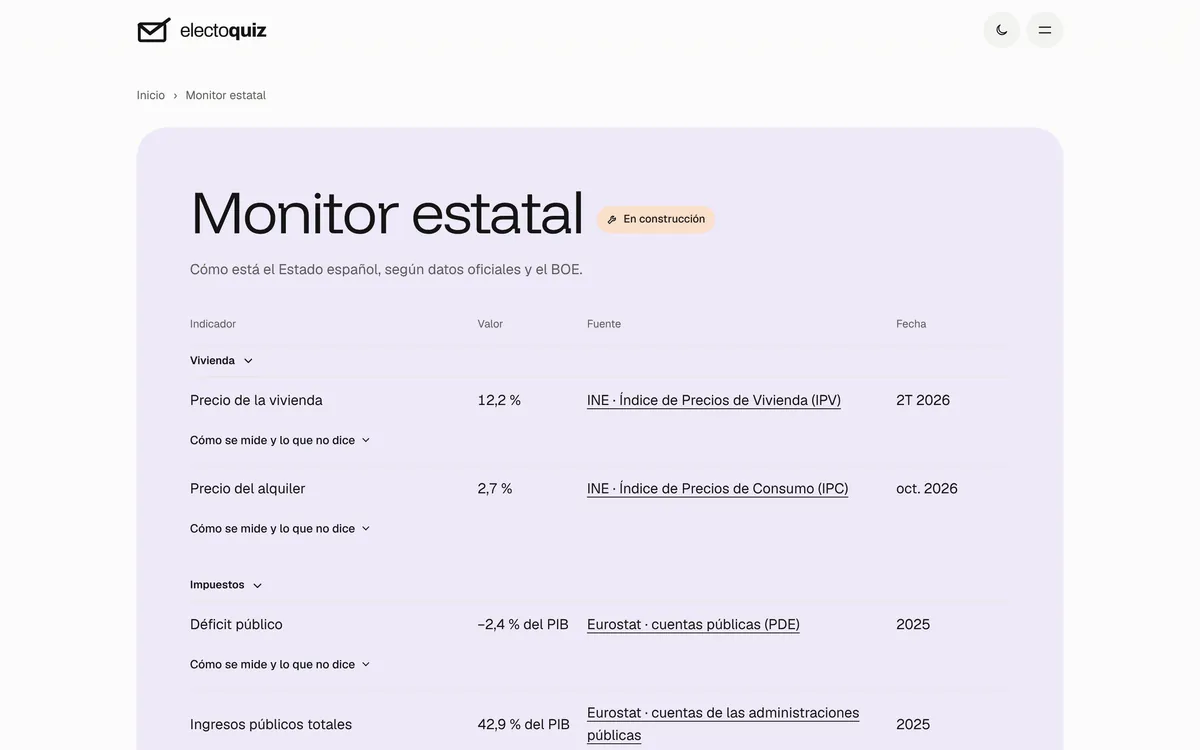
A monitor of official data that updates itself
Every quiz topic is backed by an official indicator: house prices, unemployment, deficit, waiting lists, renewable electricity… Every morning, an automated job queries the INE, Eurostat, Red Eléctrica and the BOE and updates the monitor. If a source fails, the last good figure stays and is flagged. A value is never estimated or made up.
06 · My role
I did it all, coding with AI
The concept, the manifesto and reading the party programmes to turn them into comparable cards.
Brand, visual system, quiz, monitor and the rest of the site, with light and dark themes and mobile first.
A static site with no framework, a monitor that updates daily and an anonymous counter, all built with Claude.
No cookies and no third-party scripts. Only visits and completed quizzes are counted.
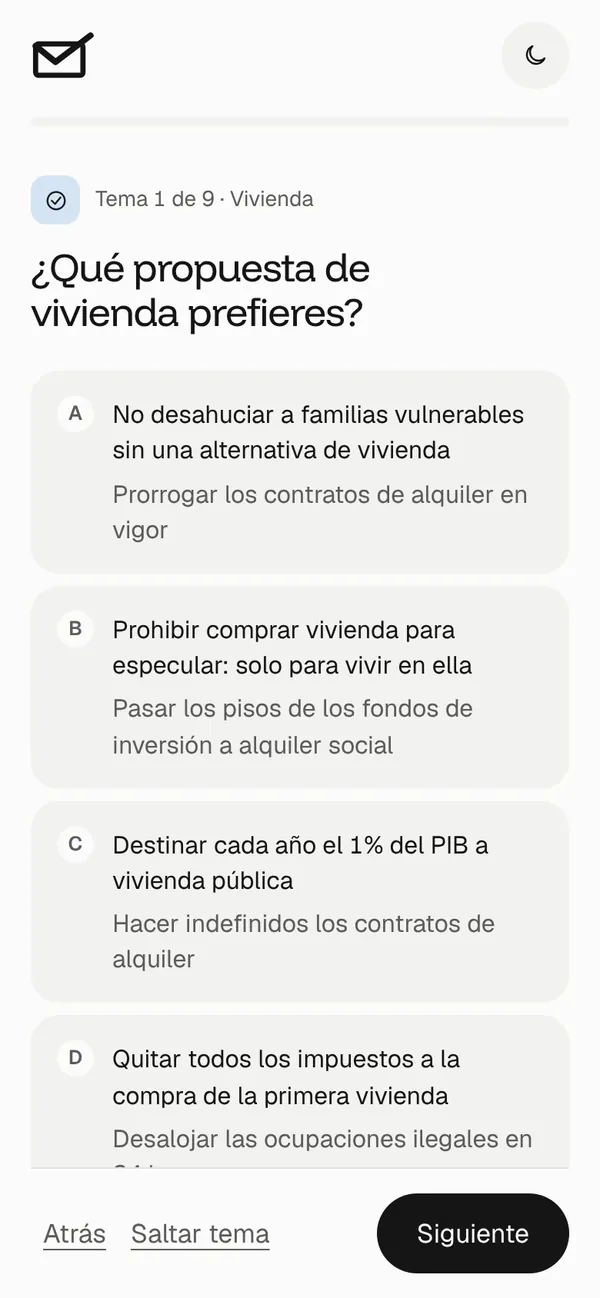
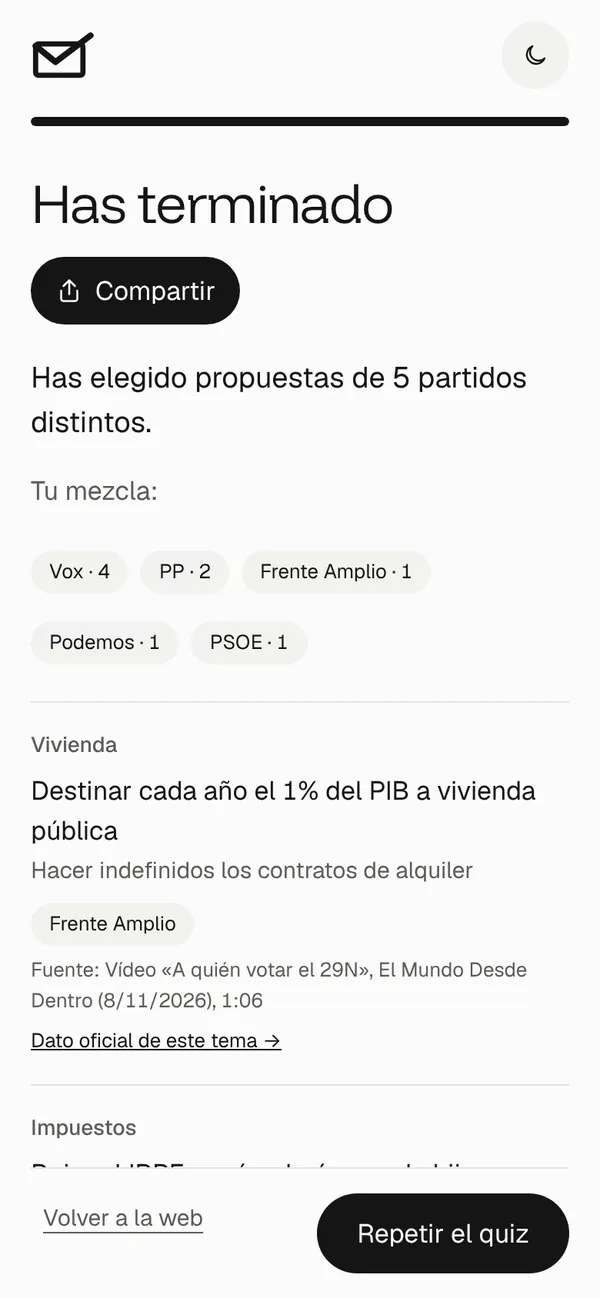
The quiz and the result on mobile.
07 · Where it is today
Live for 29 November, and keen to keep going
topics, with six proposals each.
national parties in the quiz.
cookies, and no data on what you choose.
Next: deeper quizzes with more proposals per topic, and taking the same idea to regional and local elections whenever possible.
What I learnedFor people to trust a product, promising neutrality isn't enough: they have to be able to check it on every screen.